
Maguire Products Inc. Leading the Plastics Industry in: Weigh Scale Blenders, Pumps, Feeders, Loaders, Granulator, MLAN SoftwareMaguire Products Inc. Leading the Plastics Industry in: Weigh Scale Blenders, Pumps, Feeders, Loaders, Granulator, MLAN Software
  Home
  Manuals
  Technical Support
  Brochures
  Contact Us
  Request A Quote
Products
osspace
 Blenders
    Blender Manuals
    MicroBlender
    100 Series
    200 Series
    400 Series
    900 Series
    1800 Series
    MaxiBatch
    LineMaster™
    Dispensers
    VTA Stands
    AWS Stands
    Clear-Vu Hopper
    Blender Acces.
    Communications
  Dryers
      Dryer Manuals
      LPD-30
      LPD-100
      LPD-200
      LPD-1000
      Dryer Acces.
  Loaders
      Loader Manuals
      Clear-Vu Systems
      MLS Controller
      Venturi Systems
      Loader Acces.
  Feeders
      Feeder Manuals
      Series MCF
      Series MLG
      Series MPF
      Series MRF
      Series MSF
      Feeder Acces.
  Pumps
      Pump Manuals
      MPA Peristaltic
      MDA Drum Pumps
      MPM Pre-Mixers
      Pump Acces.
  G2 Communications
      Manuals
      Overview
      Screenshots
      G2 Manuals
      Downloads
      Troubleshooting
About Us
  About Us
  Maguire in the News
  Warranty
  Marketing
  space
  Gravimetric Blenders
  space2
  Login
Feeders Series MSF


Series MSF Starve Feeders

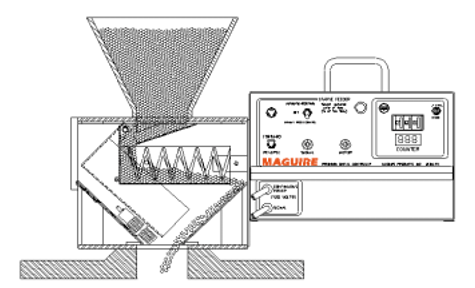
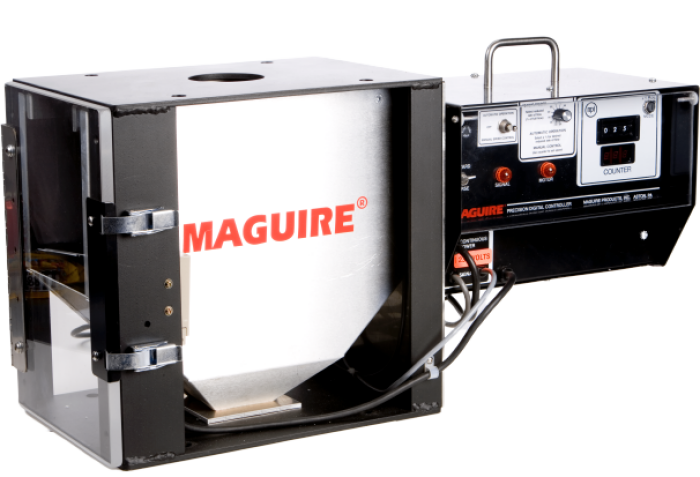
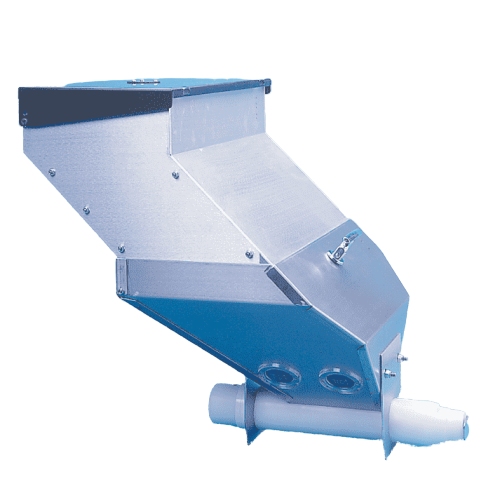
The Model MSF starve feeder carefully regulates the volume of natural material supplied to the feed throat of the process machine. The Model MSF starve feeder, weighing less than 50 pounds, is compact and easy to install. It is mounted between the existing hopper and the feed throat of the machine adding only 8 inches to the height of your hopper. Your hopper remains directly over the feed throat of your machine and is not off-set as the case with some competitors' units.

Improves Control of Vented Screw

When used in conjunction with a vented screw - the MSF starve feeder allows the operator to regulate the feed to the rear portion of the screw. If the front portion of the screw is unable to extrude plastic as rapidly as the rear portion, then the excess flow from the rear will be forced out the vent. This condition could result from:

  1. The use of back pressure during screw return time.
  2. Worn screw flights in the forward zone.
  3. Intentionally unbalanced temperatures over the length of the barrel, etc.

Use of a starve feeder allows careful regulation over the volume of material that is metered to the rear feed section of the screw, thus allowing an operator to override the tendency for material to escape from the vent.

Improves Material Processing

As plastic pellets are heated and plasticized, surface moisture and some volatiles will be driven off as vapor and steam. The vapor and steam that travel backwards will re-condense on the colder pellets in the feed zone and hopper, and then will be carried into the screw over and over again. "Starve feeding" does two things to help remedy this problem. First, a "starved" screw will have a continuous air passage directly behind the spiraling screw flight that will allow vapors to easily escape back through to the feed throat. Second, the starve feeder itself provides a vent to atmosphere so that vapors need not travel up through the cold resin in the hopper.

Reduce Drive Motor Torque

Some granular forms of resin will feed so efficiently at the feed section of the screw that the horsepower or torque available to drive the screw is not sufficient, and the drive motor becomes overloaded. Starve feeding will correct this problem by metering resin at a rate that does not exceed the horsepower or torque of the drive motor.

Control Slippage

When the feed zone of a process machine is not cooled, the plastic pellets in the throat may preheat considerably if throughput rate is low and residence time in the throat is too long. This may cause premature melting in the barrel, resulting in screw slippage which will then produce erratic and extended screw return times. Starve feeding eliminates residence time and consequently prevents screw slippage. In these situations, starve feeding actually can produce a shorter screw return time than with "flood" feeding.

No Calibration Required

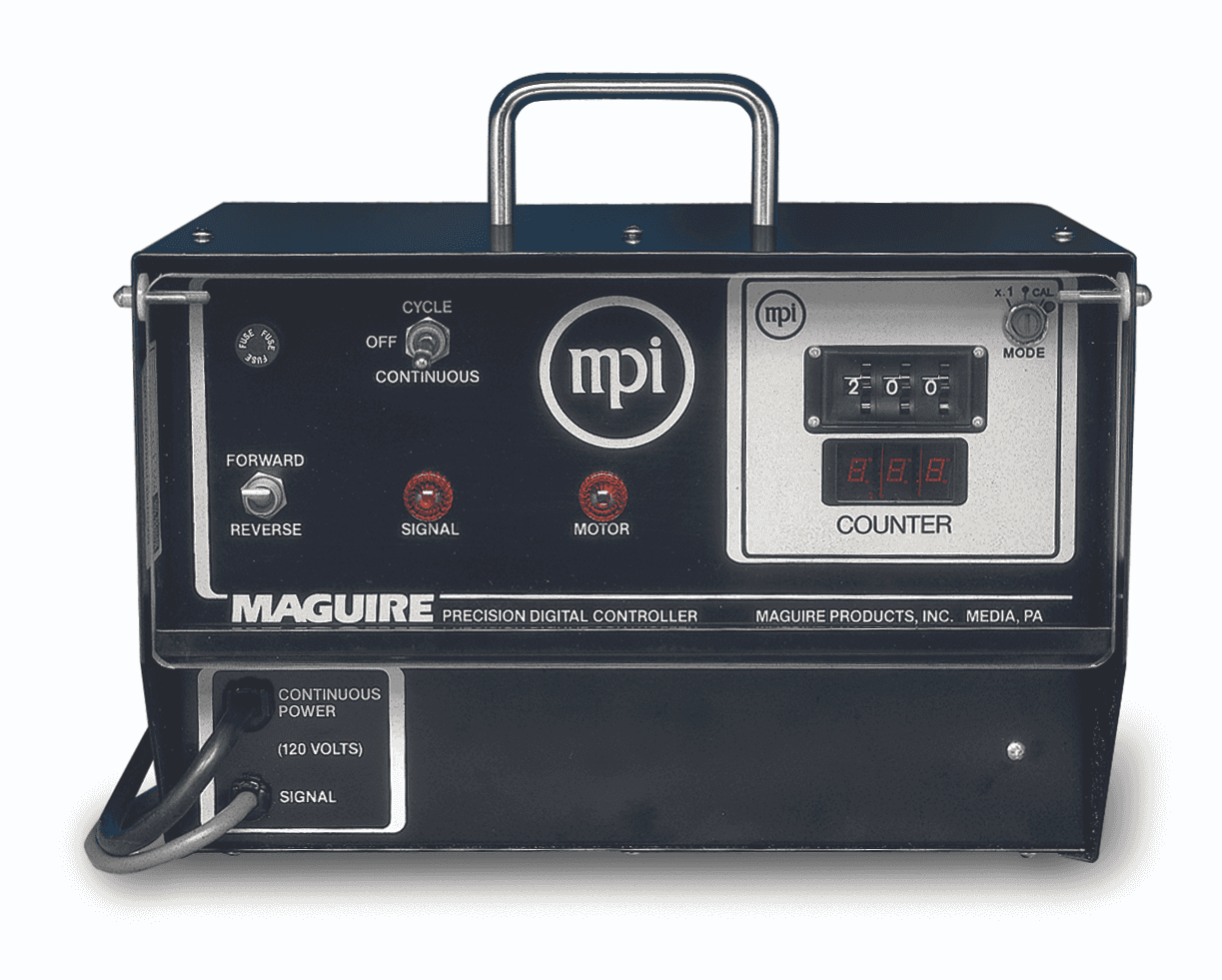
Your operator need only select the "percent" of full flow desired, such as 70 or 80%. The microprocessor will self-calibrate by first matching your molder's extrusion rate and then automatically cutting back to the selected reduced "starve" rate of feed. No calibration of the system is ever necessary.

Manual Bypass

A hinged flow plate allows conventional flood feed fo manually bypassing the "starve" system..

Maguire Products, Inc. HQ, 11 Crozerville Rd, Aston, PA 19014, USA
Phone: 610-459-4300; Phone 2: 888-459-2412 (North America); Fax: 610-459-2700;