
Maguire Products Inc. Leading the Plastics Industry in: Weigh Scale Blenders, Pumps, Feeders, Loaders, Granulator, MLAN SoftwareMaguire Products Inc. Leading the Plastics Industry in: Weigh Scale Blenders, Pumps, Feeders, Loaders, Granulator, MLAN Software
  Home
  Manuals
  Technical Support
  Brochures
  Contact Us
  Request A Quote
  .
  Straight Talk from
  Steve Maguire
Products
osspace
 Sweeper
    Model SW-50
 Blenders
    Blender Manuals
    Touchscreen
    MicroBlender
    100 Series
    200 Series
    400 Series
    900 Series
    1800 Series
    MaxiBatch
    LineMaster™
    Dispensers
    VTA Stands
    AWS Stands
    Clear-Vu Hopper
    Blender Acces.
    Communications
  Dryers
      Dryer Manuals
      LPD-30
      LPD-100
      LPD-200
      LPD-1000
      Dryer Acces.
  Loaders
      Loader Manuals
      Clear-Vu Systems
      MLS Controller
      GVL Motor Loader
      Venturi Systems
      Loader Acces.
  Feeders
      Feeder Manuals
      MGF Feeder
      Series MCF
      Series MLG
      Series MPF
      Series MRF
      Series MSF
      Feeder Acces.
  Pumps
      Pump Manuals
      MPA Peristaltic
      MDA Drum Pumps
      MPM Pre-Mixers
      Pump Acces.
  G2 Communications
      Overview
      Screenshots
      G2 Manuals
      Downloads
      Troubleshooting
About Us
  About Us
  Maguire in the News
  Warranty
  Marketing
  space
  Gravimetric Blenders
  space2
  Login
Dryers
The Maguire LPD:
A revolution in resin drying.

The Maguire Low Pressure Dryer (LPD) is a revolutionary device that uses vacuum to accelerate the resin drying process. The use of vacuum provides many process and cost benefits compared to conventional drying technology.

Maguire Products did not invent the science of low pressure (vacuum) drying. In fact vacuum drying has been used in the manufacturing process of plastic resins, chemicals, food and pharmaceuticals for many years. But, Maguire Products is the first to bring this technology to the plastics industry in a package that is affordable, reliable and simple to operate.

Why is the LPD Better?

Speed of Drying
Typically the vacuum dryer will dry materials in one-sixth the time of a desiccant dryer. If your desiccant dryer drying time is 4 hours, the vacuum dryer will do the job in 40 minutes. The result is time-savings of 3 hours and 20 minutes every time you start up a dryer. This not only represents reduced energy cost (see below), but could also represent 3 hours and 20 minutes of additional production time.

Energy Savings
Side-by-side testing of the vacuum dryer and a desiccant dryer shows reduced energy consumption of 70 - 80%. The key to the reduced energy consumption is that the vacuum dryer does not rely on desiccant. Desiccant, once saturated, must be regenerated by a heating and cooling process so it will again be able to absorb moisture. All energy required to regenerate desiccant is lost to ambient.

Reduced Maintenance
Since desiccant degrades over time it must be replaced on a regular basis. This expense is avoided with a vacuum dryer. In addition the need to monitor the condition of desiccant is eliminated.

Low Material Stress
Long drying times at elevated temperatures can cause thermal, chemical and physical material degradation. Materials if exposed to prolonged elevated temperature during drying run the risk of degradation including discoloration and/or IV drop which leads to reduced physical properties of the end product. The reduced drying time required with the vacuum dryer dramatically reduces the risk of material degradation. Since the vacuum dryer first heats up the material, then applies vacuum to accomplish drying the heating cycle is only 20 to 30 minutes.

On-The-Fly Material Change
Additional savings can be achieved with the vacuum dryer in the form of on-the-fly material changes. Since the vacuum dryer dries in batches a material or color change can be accomplished on-the-fly. This means no downtime related to clean-out of the drying hopper during a material change. Every time you have a material change with a desiccant dryer the dryer must be shutdown and the drying hopper cleaned. This is normally a time-consuming, labor-intensive process. The vacuum dryer will automatically notify the operator when it's time to conduct an on-the-fly material change. No interruption of the drying process occurs during the on-the-fly material change.

The LPD Dryer Microprocessor Controller

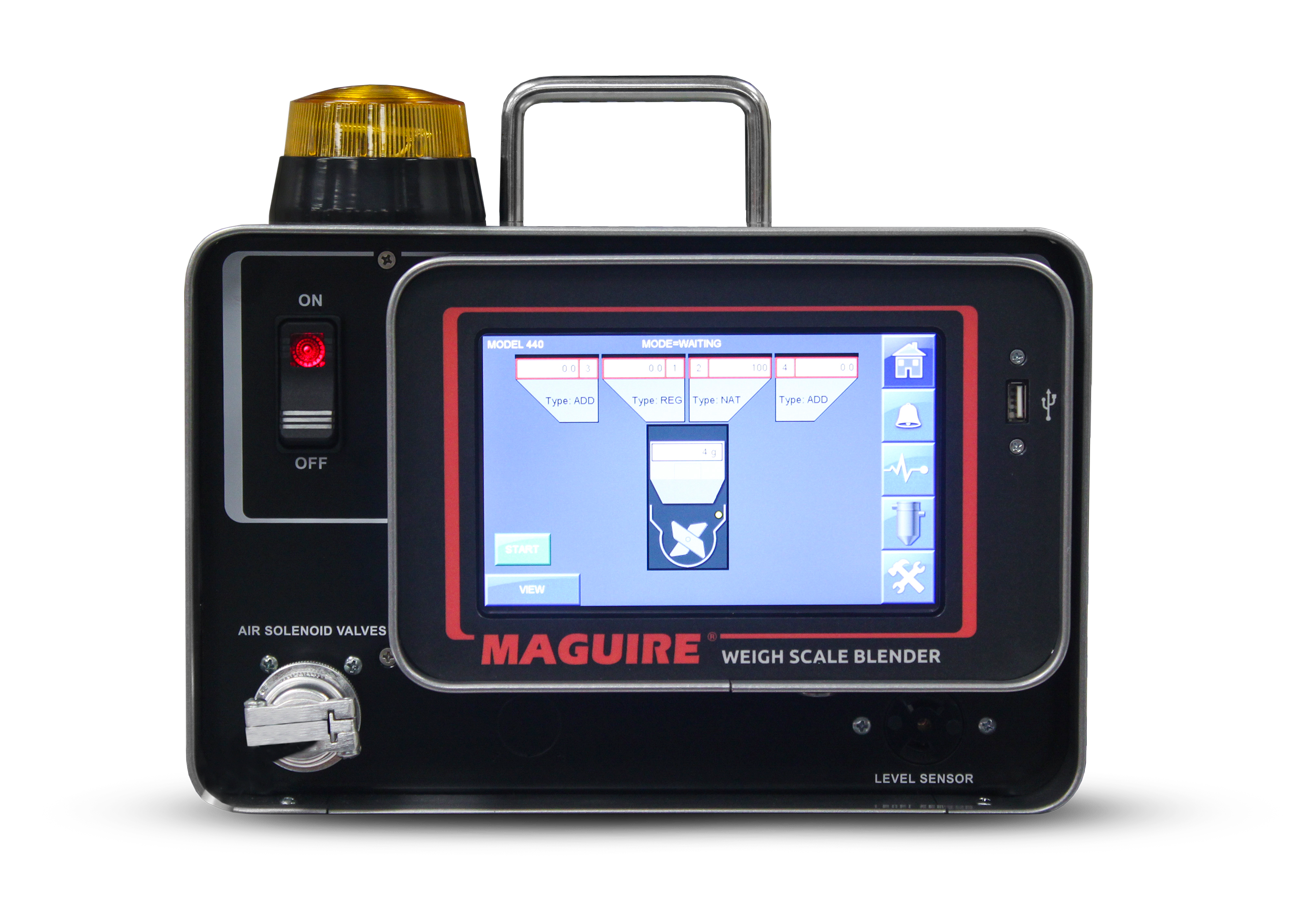
The LPD controller is very simple to use. The dryer may be operated by simply setting the proper temperature and cycle time on the thumbwheels located to the right. The display will indicate temperature and elapsed cycle time or, alternatively, temperature and vacuum level. If a problem occurs during operation an alarm strobe and horn will be activated and the nature of the problem will be indicated on the display. The controller monitors numerous alarm conditions to ensure proper performance. Comparable to a dew point monitor, vacuum level is always monitored to ensure proper vacuum level is maintained.

As an aid to monitoring dryer performance and documenting operation a printer port is provided on the controller. A printed output of dryer operation may be obtained for each drying cycle.

The controller can be easily removed for service or replacement. If you have a controller problem a complete new control panel may be installed in minutes.

Maguire Products did not invent the science of low pressure (vacuum) drying. In fact vacuum drying has been used in the manufacturing process of plastic resins, chemicals, food and pharmaceuticals for many years. But, Maguire Products is the first to bring this technology to the plastics industry in a package that is affordable, reliable and simple to operate.

How the LPD Dryer Works:

The dryer operates with 3 Stainless Steel canisters that are mounted directly onto a carousel that indexes counterclockwise 360 degrees. Through this 3 step process each canister systematically goes through the following 3 stages to dry materials.

Stage 1:
Filling: In the first stage the canister is filled with material using a specially designed dispense valve to ensure the canister can never overfill. Mounted above the dryer is a surge hopper for material resin which ensures the canister can be filled in the minimum amount of time necessary.

Heating: As the canister is being filled the heating process also begins. Temperature settings are made easily by simply dialing in the required temperature on the thumbwheels of the controller.

Due to the relatively small volume of the canisters when compared to traditional large drying hoppers the material can come up to the required temperature rapidly. Once the canister has been heated for the time set it will then index automatically to the next stage. (See Stage 2)


Stage 2

Vacuum: When the canister indexes from Stage 1, it is sealed and very strong vacuum is applied. As air pressure drops, water boils at lower temperatures. Once the material is under vacuum, the boiling point of water falls from 212°F (100°C) to 133°F (56°C). Moisture is rapidly driven from the material and evacuated to ambient air. The dryer controller continuously monitors vacuum level ensuring the vacuum remains high. If the proper level of vacuum is not maintained an alarm will sound.

Stage 3:

Material Removal: After the Vacuum cycle is completed the canister indexes again to the material take off position. Under automatic operation a valve in the bottom of the canister is opened and material then flows from the canister into a material take off pan. Dry material is then drawn by a vacuum loader to the process machine. Material level in the takeoff pan is monitored continuously by a proximity sensor. At the end of the cycle time the canister will index back to Stage 1.
Changing Materials on the LPD Dryer
The dryer comes with an innovative and time saving Clean Mode. When this is selected as soon as the proximity sensor detects that all material has been removed from the canister or the cycle time has expired, it will notify the operator by alarm. This allows for the canister to be quickly removed, cleaned and prepared for a new material.

Canister Removal and Cleaning:
Each canister is easily removed from the central carousel by releasing two latches.

Once the canister is removed and emptied all material contact surfaces can be readily accessed for quick and simple cleaning. By turning the canister upside down operators can access the screen by rotating the retaining plate and then both the plate and the screen are removed for complete cleaning.

Surge Hopper Removal and Cleaning:
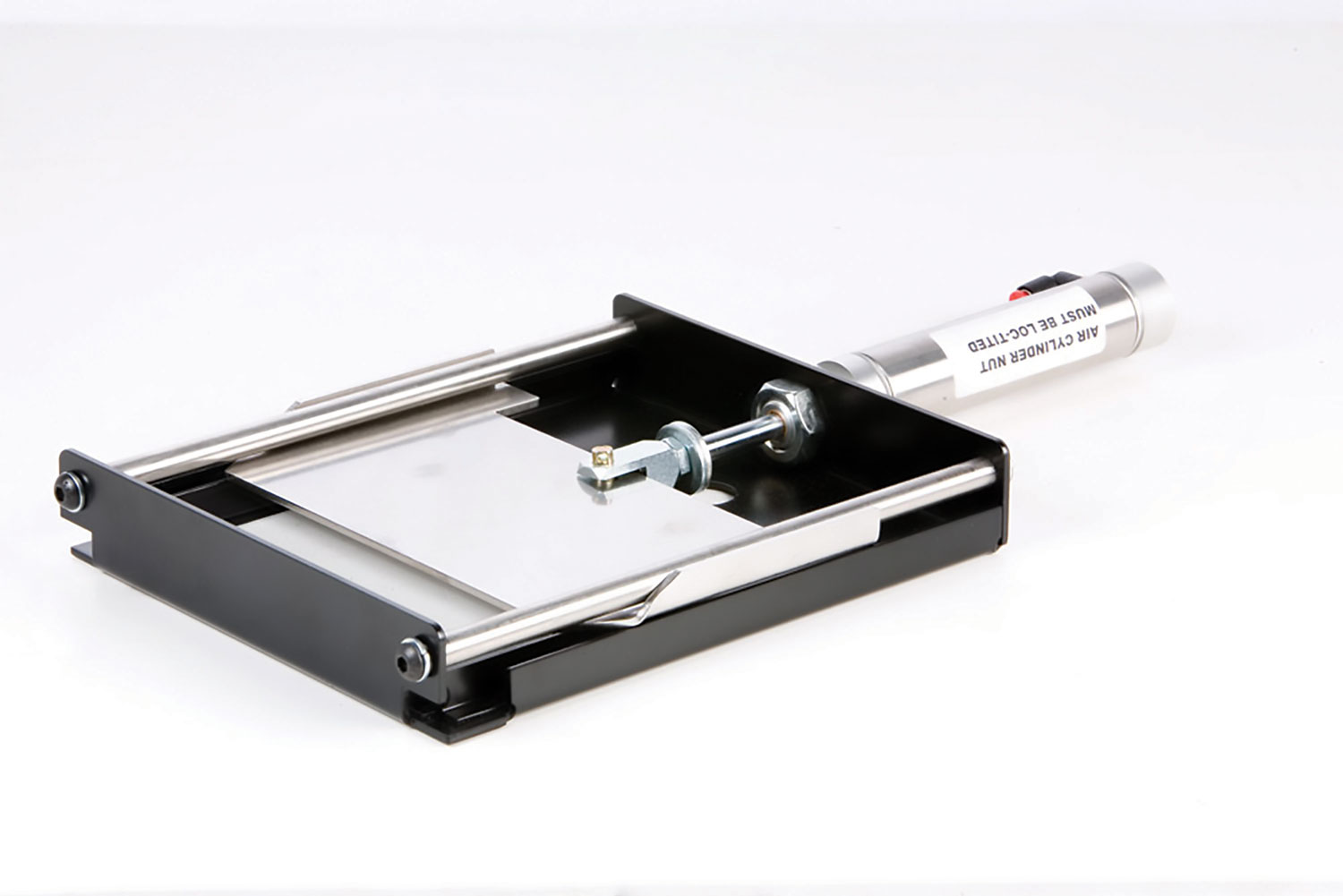
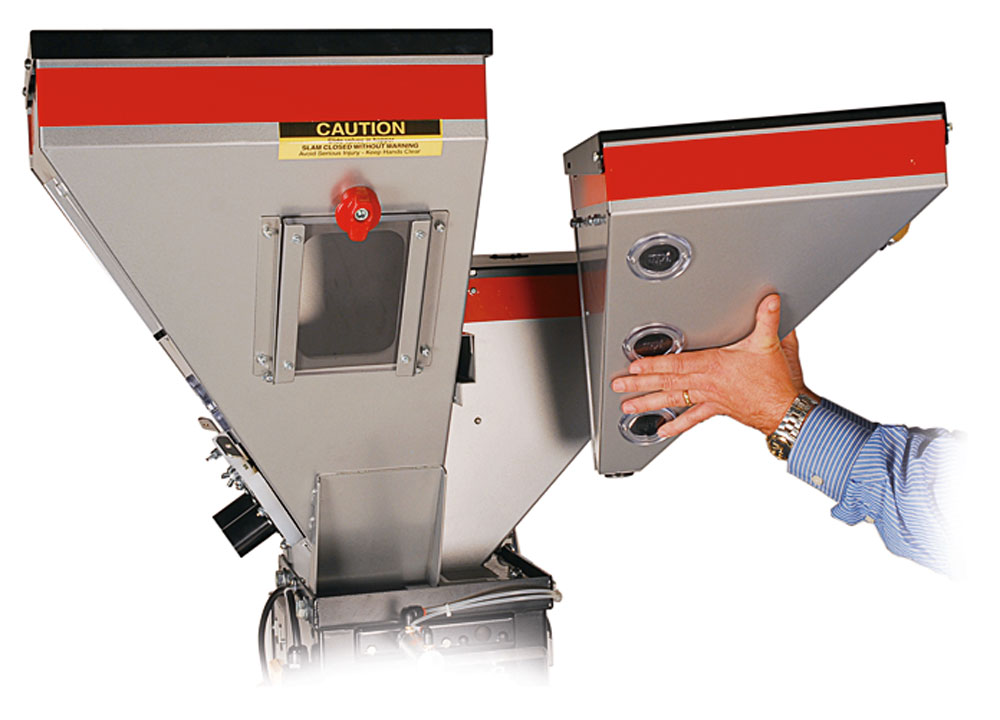
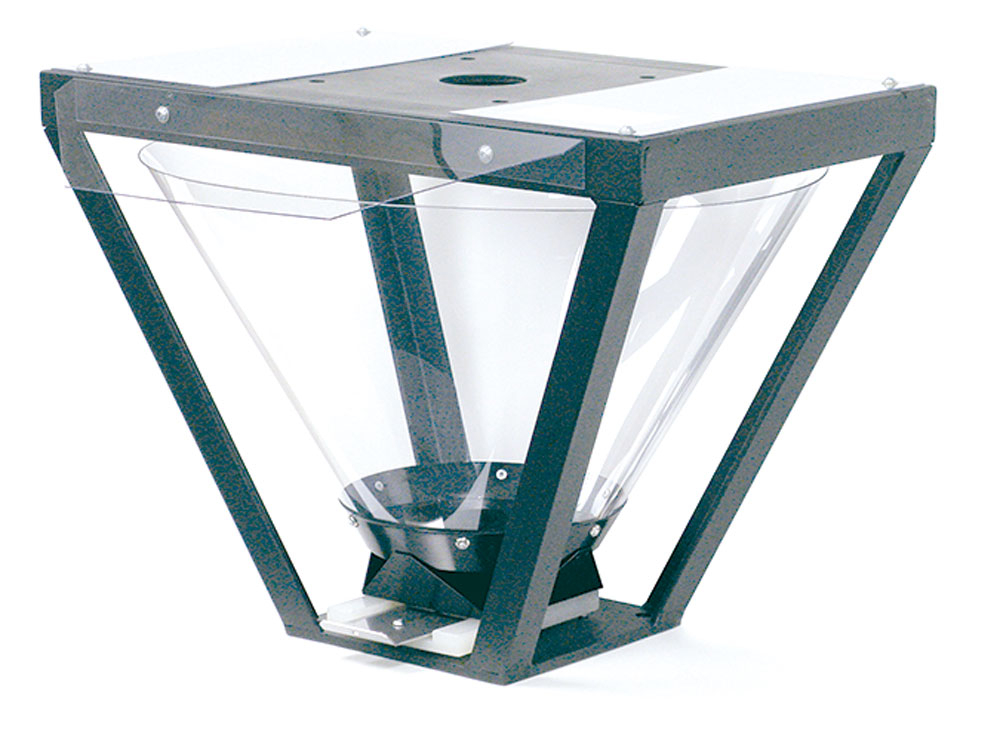
The surge hopper above the dryer is also designed to be quick and easy to remove. The lightweight hopper includes a shut-off slide gate and can be easily lifted out. The frame can then be rotated out of the way, allowing access and removal of the fill valve.

Material Take-off Pan Cleaning:
The material take off pan slides out of position for complete access and easy cleaning.

Filter Cleaning:
The dryer includes a filter that protects the blower from any carry-over of dust or fine particles. The filter requires cleaning periodically and this can be achieved by removal of the quick access panel on the front of the dryer.

Dryer Specifications
LPD 30 LPD 100 (LPD 12) LPD 200
Regional Specifications USA Europe / Asia USA Europe / Asia USA Europe / Asia
Standard version max. 350° F 180° C 350° F 180° C 350° F 180° C
Throughput 30 lb/h 15 kg/h 100 lb/h 50 kg/h 200 lb/h 90 kg/h
Canister volume 0.32 cu ft 9 l 1.1 cu ft 30 l 2 cu ft 57 l
Empty weight 550 lb 250 kg 730 lb 250 kg 950 lb 430 kg
Packing weight 620 lb 280 kg 800 lb 360 kg 1010 lb 460 kg
Packing dim.
(L x W x H)
40"x35"x75" 100x90x190 cm 40"x35"x85" 100x90x220 cm 40"x35"x95" 100x90x240 cm
Heater element 3 kW / 13A 3 kW / 13 A 5 kW / 22A 5 kW / 22 A 5 kW / 22 A 5 kW / 22 A
Blower 0.5 hp /2.5 A 0.37 kW / 2.5 A 2.5 hp /6.2 A 1.86 kW / 6.2 A 3.5 hp /6.2 A 2.6 kW / 6.2 A
Total Power Supply 460V/3Ph/60Hz 400V/3Ph/50Hz 460V/3Ph/60Hz 400V/3Ph/50Hz 460V/3Ph/60Hz 400V/3Ph/50Hz
3.47 kW / 16 A 3.47 kW / 16 A 6.96 kW / 20 A 6.96 kW / 20 A 7.7 kW / 30 A 7.7 kW / 20 A
Compressed air requirement 70-90 psi 6 - 8 bar 70-90 psi 6 - 8 bar 70-90 psi 6 - 8 bar
Compressed usage 0.4 cfm 0.7 m3/h 2 cfm 3.4 m3/h 2.4 cfm 4 m3/h
* US voltage: 480, Europe / Asia voltage: 400

Drying Times
This table shows the latest
recommended specifications for drying conditions. If the material you are running is not on this list, please contact Maguire to arrange testing.

MATERIAL

FINAL MOISTURE % *

CYCLE TIME (MINUTES)**

DRYING TEMPERATURE***

ºC ºF
ABS

0.10

20 - 25

80 - 85

180 - 190

ABS/PC

0.02

25 - 30

100

210

LCP

0.02

20 - 50

150

300

PA

0.20 - 0.10

20 - 30

80 - 85

180 - 190

PBT

0.02

20 - 25

120

250

PC

0.02

20 - 25

120

250

PC/PBT

0.02

20 - 25

125

250

PEEK

0.20 - 0.10

25 - 30

150

300

PEI

0.02

40 - 60

150

300

PES

0.05 - 0.02

25 - 30

150

300

PET (Molding Grade)

0.010

30 - 35

150

300

PET (Preform, Ext.)

0.005

30 - 35

150

300

PMMA (Acrylic)

0.02 - 0.04

30

85

185

POM (Acetal)

0.20 - 0.10

25

80 - 110

180 - 230

PPO

0.02

25

100 - 120

210 - 250

PPS

0.02

25

150

300

PUR

0.02

25

125 - 140

260 - 280

PSU

0.02

25 - 30

150

300

SAN

0.20 - 0.10

20 - 40

80

180

Please note the following:
* Final moisture content as recommended by the raw material manufacturer.
** Recommended cycle time is based on average initial moisture content. For high initial moisture content cycle time should be extended 5 minutes. When in doubt please contact Maguire service.
*** Drying temperature as recommended by the material manufacturer.

Maguire Products, Inc. HQ, 11 Crozerville Rd, Aston, PA 19014, USA
Phone: 610-459-4300; Phone 2: 888-459-2412 (North America); Fax: 610-459-2700;