


Why the greatest return on an ULTRA dryer isn't the energy bill. It's the production time you didn't know you were losing.
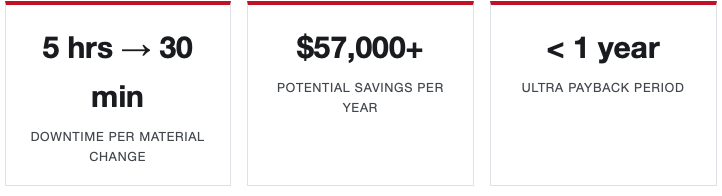
For many processors, the greatest return on investment provided by ULTRA dryers is not energy, it is productivity. Conventional desiccant drying quietly taxes production every time material changes: draining and storing the hopper, reloading, and then waiting hours for the new resin to dry. For a processor changing material just once a week, that waiting adds up to roughly 250 hours of lost production a year, $50,000 at a production value of $200 per hour.
ULTRA changes the equation. It heats and dries a new batch in under an hour, while production continues on the current material, shrinking changeover downtime to little more than the mold change itself. Add the elimination of "leftover" dried material, plus the labor, material losses, and warehouse space that go with it, and ULTRA could save a typical processor well over $57,000 a year, before even counting its dramatically lower electrical power costs.
The bottom line for decision-makers: ULTRA pays for itself in under a year. The sections that follow walk through exactly where that money is hiding in your process today, and how ULTRA recovers it.
Can a dryer really increase productivity?
It may seem that drying should have no impact on productivity at all. The dryer runs, the material dries, production carries on. For some processors, that is true.
But for many, probably most, it isn't. The reason is simple: less downtime, less wasted start-up time, and shorter material changeover times. Most processors run different products, use different resins or different blends, and must drain the current material from the dryer hopper to refill with a new resin or blend. Or an issue arises with the material currently being run, which must be removed and replaced with the correct material, followed by the long wait to dry that new batch.
Every one of those events stops production. And every hour production stands still has a price.
Where does the time actually go when you change materials?
Every customer is different, and your process will be different. But consider a working example built on a few straightforward assumptions: a material change occurs once a week, production time is valued at $200 an hour, and the process consumes 225 kg (500 pounds) per hour.
When a production run ends, the material remaining in the drying hopper must be drained and stored for a future run, in this example, 900 kg (2,000 lbs). That removal and storage can take an hour. Then the new resin is loaded into the hopper, where it requires four hours of drying before it is ready for production. Four more hours of idle production time.
One material change per week means five hours of lost production every week.
What is that lost time actually worth?
The math is rather simple: 5 hours per week, across 50 weeks, is 250 hours. At $200 an hour, your lost production time is valued at $50,000 per year.
That is with just one material change a week. Many processors change materials every day or two. For them, the losses can be double what this example suggests.
How does ULTRA turn five hours of downtime into thirty minutes?
ULTRA is dramatically different. It can heat and dry a new batch in less than one hour, and it can do this at the same time you are still running production with your current blend. In the time it takes to pull a mold from a press and mount the new one, ULTRA has already prepared your next material for production.
Your downtime is now just your mold changeover time. Assuming a mold change takes 30 minutes, lost production time falls from 5 hours to half an hour per change. Half an hour a week, over 50 weeks, is 25 hours, $5,000 instead of $50,000.
Savings per year: $45,000, from recovered production time alone.
What about the material you dried but never used?
Here is a cost most processors have stopped seeing. At the end of a run, desiccant-dried material that was not consumed becomes "leftovers," and we often see warehouses filled with them. On a much smaller scale, think of leftovers in your refrigerator at home.
ULTRA, with proper setup, can completely eliminate these leftovers, along with all the related labor, planning, and space required to deal with them. During production, ULTRA learns your process throughput from weight readings taken by its built-in load cells. You can enter exactly how much production you plan to run, or simply the time of day you want production to end, and ULTRA times your material changeover perfectly. There is no leftover material for you to deal with.
The ability to schedule production this precisely produces real savings. They are difficult to quantify exactly, but it is reasonable to assign value to reduced inventory labor and to avoided material losses, "shrinkage" from spillage or contamination.
What are the hidden costs, labor, losses, and warehouse space?
Beyond lost production time, the leftovers economy carries three further costs worth counting.
Handling labor. Estimated at one hour per changeover, handling leftover material adds another $2,000 a year.
Raw material losses. Losses and inadvertent contamination from handling can reasonably be assumed to run at least 2% of total leftover material. It adds up: one changeover per week might produce a loss of 40 pounds per week, 2,000 pounds per year, worth between $2,000 and $5,000 a year.
Warehouse space. Stored leftovers occupy warehouse space you almost certainly have another use for. A 25 × 40 foot space, 1,000 sq ft (100 sq m), at $5 per square foot is $5,000.
What does it all add up to?
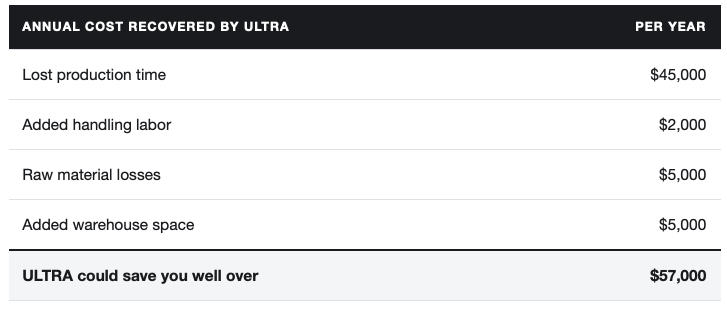
And don't forget to include ULTRA's dramatically reduced electrical power costs. ULTRA cuts dryer electric bills in half or better.
It is hard to deny the reality. ULTRA pays for itself in under a year.
What if your process is different?
It will be. Every customer is different, and your savings will depend on your particular process. Some processors run one material for a month or more, and for them the productivity case is smaller. But many change materials every day or two. For them, the savings can be double what this example suggests.
The figures here are a framework, not a promise. Adjust them to reflect your current processing costs, your hourly production value, your changeover frequency, and your material prices, then see what the reality looks like for your plant.
Why ULTRA outperforms desiccant drying